
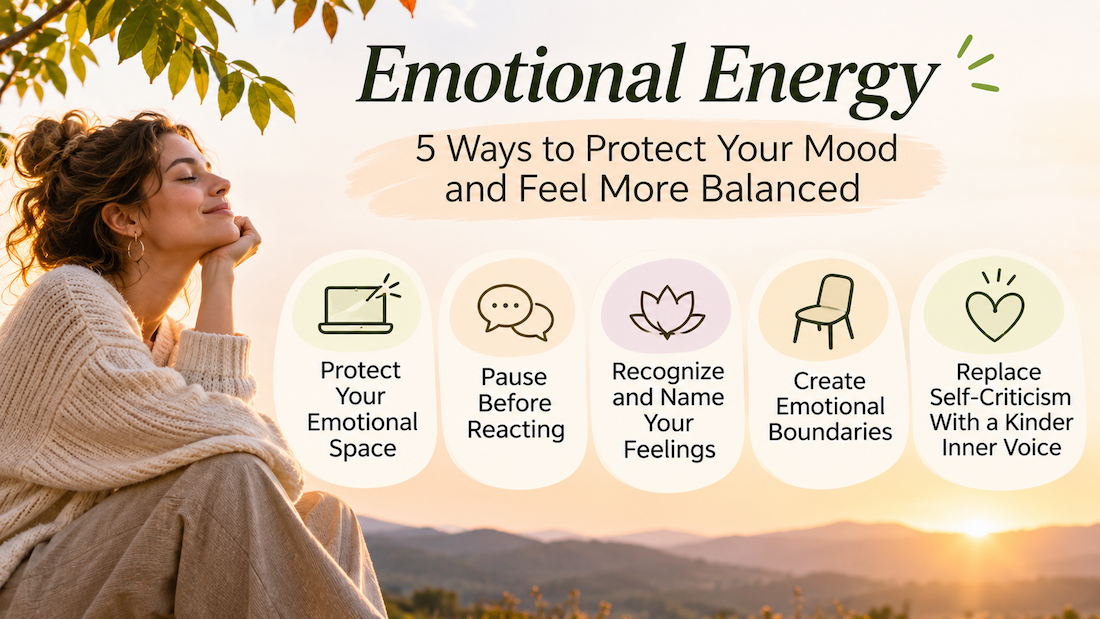
Emotional Energy: 5 Ways to Protect Your Mood and Feel More Balanced
Have you ever noticed how a difficult conversation, a stressful day, or even a few minutes of scrolling can change your mood?
Emotional exhaustion doesn’t always come from major life events. Sometimes it builds up through everyday experiences: too much negative information, unresolved feelings, difficult relationships, or constant self-criticism.
Looking after your emotional energy doesn’t mean trying to stay positive all the time. It’s about understanding what affects you, recognizing your emotions, and finding healthier ways to respond.
Here are five practical ways to protect your emotional well-being and develop greater emotional awareness.
1. Protect Your Emotional Space
News, social media, online discussions, and other people’s opinions are constantly competing for our attention. Even when we’re not actively looking for something upsetting, we can come across content that leaves us feeling anxious, frustrated, or overwhelmed.
The same can happen in everyday relationships. Some conversations leave us feeling supported, while others involve constant complaints, gossip, or criticism.
You don’t have to disconnect from the world, but you can become more selective about what you give your attention to.
Try this:
- Limit how often you check the news and social media.
- Mute accounts that regularly leave you feeling anxious or inadequate.
- Take breaks from conversations that revolve around gossip or negativity.
- Give yourself some phone-free time during the day.
Notice how you feel after certain interactions or activities. This simple self-reflection can help you recognize what supports your emotional wellness and what drains your energy.
Remember: you can listen to someone without taking every opinion or emotion personally.
2. Pause Before Reacting
When we’re upset, it’s easy to start blaming the other person:
- “You never listen to me.”
- “You always do this.”
- “Everything is your fault.”
But these statements often make people defensive and turn a conversation into an argument.
A more constructive approach is to explain what you’re feeling instead of immediately accusing someone. This is often called using I-statements.
For example:
Instead of:
“You never listen to me!”
Try:
“I feel frustrated when I’m interrupted because I want to finish explaining what I mean.”
Before responding, ask yourself:
What do I want to achieve with this conversation? Do I want to solve a problem, explain how I feel, or simply release my frustration?
A simple formula to try:
- I feel… Name your emotion.
- When… Describe what happened.
- Because… Explain why it matters to you.
- I would like… Say what you need.
You don’t have to avoid difficult conversations. You can learn to have them without turning every disagreement into a fight. This is an important part of developing emotional regulation skills.
3. Learn to Recognize and Name Your Feelings
Sometimes we know that something is wrong, but we can’t explain exactly what we’re feeling.
We might say we’re having a bad day, when underneath there is disappointment, loneliness, resentment, embarrassment, or fear.
Learning to understand your emotions starts with giving them names.
Instead of asking only “Why do I feel bad?”, try exploring what is happening beneath that general feeling.
Try this daily emotional check-in:
Set aside two or three minutes once a day and ask yourself:
- What am I feeling right now?
- What happened that might have triggered this emotion?
- What do I need at this moment?
Try to be specific. For example, instead of writing “I’m upset”, you might discover that you feel disappointed because someone didn’t keep a promise.
You can use the Emotions Wheel to explore your feelings, find the right words to describe them, and try simple emotional self-regulation practices.
The more familiar you become with your emotions, the easier it can be to understand your needs and communicate them to others.
Give Your Emotions a Healthy Outlet
Naming an emotion is an important first step, but sometimes you also need a way to process it.
If a feeling stays with you, try writing down your thoughts, talking to someone you trust, going for a walk, moving your body, or doing something creative.
You don’t have to find an immediate solution or push the feeling away. Sometimes giving yourself time and space to work through it is enough to understand what you need next.
4. Learn to Create Emotional Boundaries
Have you ever finished a conversation and found yourself replaying someone’s words in your head for hours?
Sometimes we carry other people’s frustration, complaints, criticism, or worries long after the conversation has ended. We keep thinking about what they said, how they said it, and what we should have replied.
Being empathetic doesn’t mean taking on every emotion around you. You can listen to someone, care about their feelings, and still protect your own emotional space.
One simple visualization shared in the talk can help you practise this.
Try the Empty Chair Exercise:
Imagine there’s an empty chair next to you. When someone says something negative, critical, or emotionally overwhelming, picture placing their words on that chair instead of taking them into yourself.
You don’t have to argue, defend yourself, or immediately react. Just imagine setting those words aside and remind yourself:
I can hear what this person is saying without taking everything personally.
This doesn’t mean ignoring important conversations or dismissing someone’s feelings. It’s simply a way to create some mental distance and avoid carrying every negative interaction with you.
What if it’s someone close to you?
With people who matter to you, simply setting their words aside may not be enough. If something has hurt you, it’s worth returning to the conversation when you’re ready. The I-statement approach from the previous section can help you explain how you feel without turning the discussion into blame.
Remember: you can care about someone without taking responsibility for every emotion they experience.
5. Replace Self-Criticism With a Kinder Inner Voice
Think about how you speak to yourself after making a mistake.
- “I should have done more.”
- “Why am I so disorganized?”
- “I never get anything right.”
Many of us are much more critical of ourselves than we would ever be towards a friend.
Over time, this kind of inner dialogue can make everyday difficulties feel like personal failures.
One exercise from the talk is to try a day without self-criticism. Notice when you start putting yourself down and pause before repeating that thought.
Another useful practice is to try the phrase “The good thing is…” to find a more balanced perspective.
For example:
- “I didn’t finish everything I planned today. The good thing is that I made time to rest.”
- “I made a mistake. The good thing is that I now know what I can do differently.”
- “I didn’t exercise today. The good thing is that I listened to my body and rested when I needed to.”
This isn’t about pretending everything is positive. It’s about recognizing that one imperfect moment doesn’t cancel out everything you’ve done well.
Try this at the end of each day:
Write down three things you appreciate about yourself. They don’t have to be big achievements:
- I handled a difficult conversation calmly.
- I made time for someone I care about.
- I tried something even though I felt uncertain.
- I allowed myself to rest when I needed it.
You deserve the same understanding and encouragement that you so easily offer to others.
Final Thoughts
Protecting your emotional energy doesn’t mean avoiding every difficult situation or trying to control how you feel.
It’s about becoming more aware of what affects you, giving yourself space to process your emotions, and choosing how you respond.
You don’t have to change everything at once. Start with one small practice that feels relevant to you today. Over time, these small choices can help you build greater emotional awareness and feel more balanced in everyday life.