
Surprised: What It Feels Like and Why It Happens
What does surprised mean in everyday life?
Feeling surprised happens when something unexpected catches your attention or changes what you thought was going to happen.
It can happen when you receive unexpected news, meet someone you didn’t expect to see, discover something new, or experience a sudden change in a situation.
Surprise can be pleasant, unpleasant, or somewhere in between. You might feel excited when something wonderful happens, confused when you don’t understand what you’ve just experienced, or shocked when something happens that you never expected.
Sometimes surprise lasts only a few seconds. Other times, it can turn into another emotion as you begin to understand what happened.
Being surprised isn’t necessarily a positive or negative experience. It is your mind and body reacting to something that didn’t fit your expectations. If you’re not sure exactly what you’re feeling, Emotion Wheel can help you explore the different shades of surprise and find a word that feels right.
What might surprise be telling you?
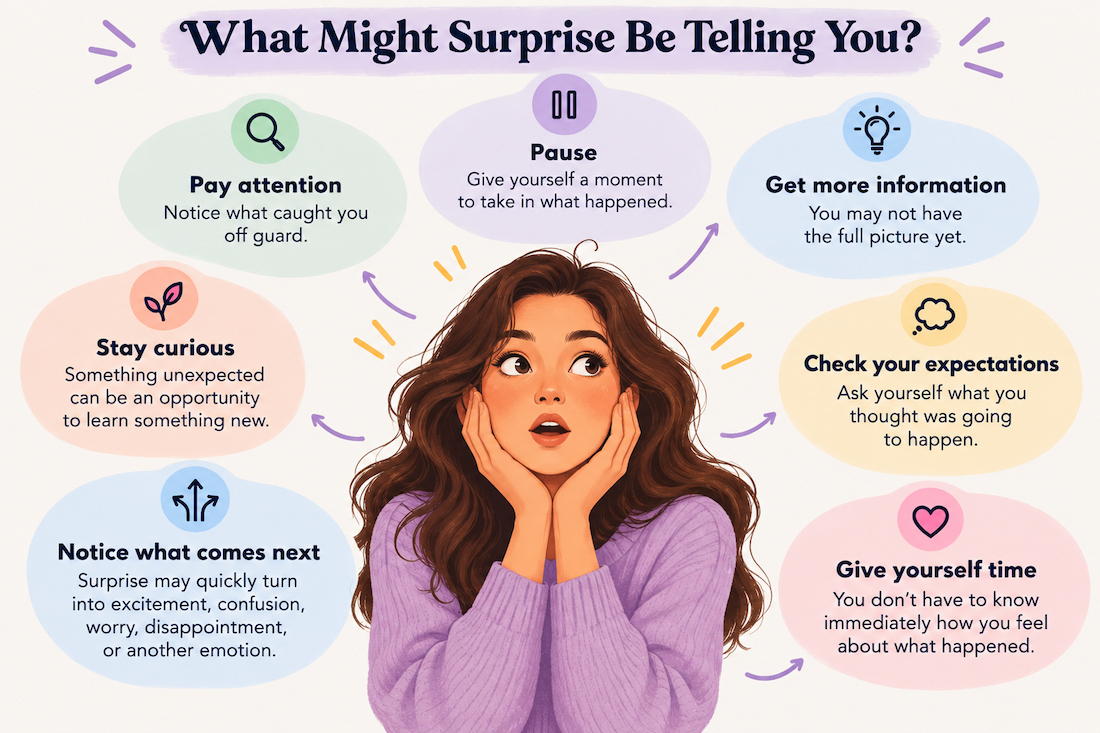
Surprise can be a little signal that something doesn’t match what you expected. It can make you stop, pay attention, and take a closer look at what is happening.
You might want to:
- Pause – give yourself a moment to take in what happened.
- Pay attention – notice what caught you off guard.
- Get more information – you may not have the full picture yet.
- Stay curious – something unexpected can be an opportunity to learn something new.
- Check your expectations – ask yourself what you thought was going to happen.
- Notice what comes next – surprise may quickly turn into excitement, confusion, worry, disappointment, or another emotion.
- Give yourself time – you don’t have to know immediately how you feel about what happened.
Sometimes surprise is simply your mind saying:
“This wasn’t what I expected. Pay attention.”
And once you understand what happened, you may discover what you really feel about it.
The different shades of surprise
Surprise can feel very different depending on what caused it.
You might be startled when something happens suddenly, like hearing a loud noise or someone appearing unexpectedly.
You might feel shocked when something happens that is much more serious or unexpected than you could have imagined.
If you don’t understand what just happened, you may feel confused or perplexed. Your mind is trying to make sense of something that doesn’t fit with what you expected.
Sometimes surprise is much more positive. You might feel amazed or astonished when something is so impressive or unexpected that it leaves you speechless.
And sometimes surprise brings a rush of positive energy. You may feel excited, eager, or energetic when an unexpected opportunity or experience makes you want to see what happens next.
You can also feel awe when something unexpected feels beautiful, powerful, or much bigger than you expected.
How surprise can feel
Surprise can happen so quickly that you may notice it in your body before you have time to understand what you’re feeling.
In the Mind
You may notice:
- suddenly thinking, “What just happened?”
- trying to make sense of new information
- becoming very focused on what is happening
- feeling curious about what comes next
- needing a moment to process what you’ve heard or seen
- quickly changing your expectations
- having lots of questions
In the Body
You might experience:
- a sudden increase in your heartbeat
- widened eyes or raised eyebrows
- a quick intake of breath
- feeling tense or frozen for a moment
- a sudden rush of energy
- feeling more alert
- warmth or a flushed feeling
In Behavior
You might:
- stop what you’re doing
- become quiet for a moment
- stare or look around
- ask, “What happened?”
- laugh or smile
- step back
- immediately tell someone what happened
- want to find out more
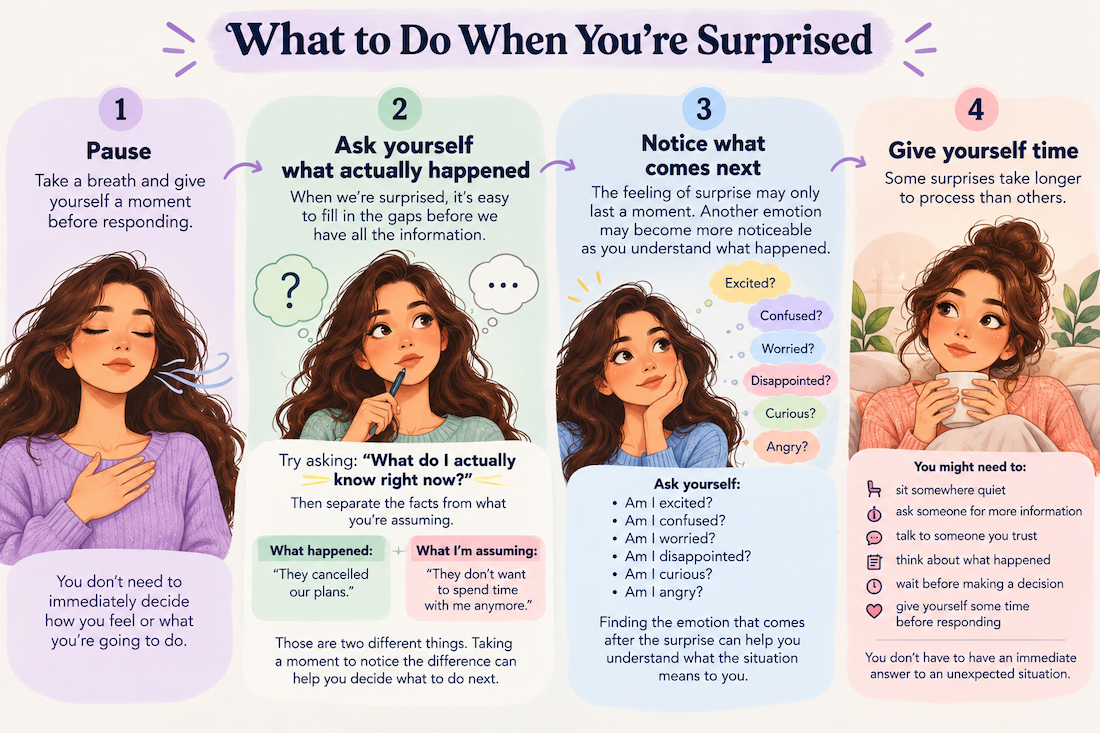
What to do when you’re surprised
You don’t have to react straight away.
When something catches you off guard, give yourself a moment to take it in. This can be especially helpful when the surprise is unpleasant or involves important news.
Pause
Take a breath and give yourself a moment before responding.
You don’t need to immediately decide how you feel or what you’re going to do.
Ask yourself what actually happened
When we’re surprised, it’s easy to fill in the gaps before we have all the information.
Try asking:
What do I actually know right now?
Then separate the facts from what you’re assuming.
For example:
What happened:
“They cancelled our plans.”
What I’m assuming:
“They don’t want to spend time with me anymore.”
Those are two different things. Giving yourself time to notice the difference can help you respond rather than react.
Notice what comes next
The feeling of surprise may only last a moment. Then another emotion can take over.
Ask yourself:
- Am I excited?
- Am I confused?
- Am I worried?
- Am I disappointed?
- Am I curious?
- Am I angry?
Finding the emotion that comes after the surprise can help you understand what the situation means to you.
Give yourself time
Some surprises take longer to process than others.
You might need to:
- sit somewhere quiet
- ask someone for more information
- talk to someone you trust
- think about what happened
- wait before making a decision
- give yourself some time before responding
You don’t have to have an immediate answer to an unexpected situation.
Quick reminder: What to do when you’re surprised
1. Pause
Take a breath. Don’t react straight away.
2. Check the facts
Ask: What do I actually know right now?
3. Notice your emotion
Ask: What am I feeling now — confused, worried, excited, angry, or something else?
4. Give yourself time
You don’t have to respond or make a decision immediately.
5. Decide what you need
More information? A little space? A conversation? Time to think?
Pause → Understand → Feel → Decide
When surprise feels good
Not every surprise needs to be figured out.
Sometimes the best part of surprise is simply enjoying the moment.
An unexpected compliment, a spontaneous invitation, good news, a beautiful view, or discovering something new can leave you feeling amazed, excited, curious, or joyful.
You might notice a feeling like:
Surprised → Amazed → Curious
or:
Surprised → Excited → Eager
These moments can bring a welcome break from your usual expectations and make you look at something in a new way.
What happens after surprise?
Surprise is often just the beginning of an emotional reaction.
Once you understand what happened, another emotion may become more noticeable.
For example:
Unexpected good news → Surprised → Excited → Happy
Unexpected criticism → Surprised → Hurt → Angry
A sudden change → Surprised → Confused → Worried
Discovering something new → Surprised → Amazed → Curious
This is why it can be useful to pause after a surprising moment and ask yourself:
“Now that I’ve had a moment to take this in, what am I actually feeling?”
The answer may be different from your first reaction.
Why surprise can be useful
Surprise gets your attention.
When something unexpected happens, you naturally become more alert and start looking for information.
That can help you notice opportunities, understand changes, and respond to something that needs your attention.
Surprise can also make you curious. Something unexpected may encourage you to ask questions, explore, or look at a familiar situation differently.
Not every surprise needs to lead to action. Sometimes it simply gives you a moment to stop and notice something new.
When surprise doesn’t feel good
Some surprises can be difficult to process.
Unexpected bad news, a sudden change of plans, an argument, or something frightening can leave you feeling shocked, confused, or overwhelmed.
If this happens, you don’t need to force yourself to understand everything immediately.
Start with something simple:
- take a few slow breaths
- sit somewhere comfortable
- notice what is around you
- drink some water
- talk to someone you trust
- give yourself some time before making a decision
Once the initial shock passes, you may have a clearer idea of what you’re actually feeling.
Final thought
Surprise can be brief, intense, exciting, confusing, or even overwhelming.
You might feel startled by something small or completely amazed by something you never expected. And sometimes you won’t know how you feel until the initial surprise has passed.
That’s okay.
You don’t have to understand your reaction immediately. Give yourself a moment, notice what comes next, and let yourself discover what the experience means to you.
Not sure exactly what you’re feeling? Use the Emotion Wheel to explore the different shades of surprise and find the word that fits your experience more closely.