
Apathetic: What It Feels Like and Why It Happens
What does apathetic mean in everyday life?
Have you ever had days when nothing seems particularly interesting? You answer messages, finish your tasks, and go about your routine, but you don’t feel very involved in any of it. Things that used to excite you may feel ordinary, and even making plans can seem like too much effort.
You might know that something matters to you, yet struggle to feel interested enough to do anything about it. You may spend time with friends without feeling connected, put off things you usually enjoy, or find yourself thinking, “What’s the point?”
This is what feeling apathetic can be like. The apathetic meaning is a reduced sense of interest, motivation, or emotional involvement. It doesn’t necessarily mean you don’t care, and it certainly doesn’t mean you’re lazy or selfish.
Sometimes this feeling passes after a period of rest or a change in circumstances. Other times, it sticks around and begins to affect your everyday life. Understanding what might be behind it can help you work out what you need.

What this emotion may be telling you
Apathy doesn’t always have a clear cause or hidden message. Sometimes it appears when you’re exhausted, under pressure, or disconnected from the things that usually give your life a sense of interest or meaning.
If you’re wondering what causes apathy, there isn’t one universal answer. Possible contributing factors include:
- Stress and exhaustion: when you’ve been dealing with too much for too long, you may have less energy left for things outside your immediate responsibilities.
- Disappointment: repeated setbacks can make it harder to feel hopeful or excited about what comes next.
- Feeling overwhelmed: when everything feels demanding, you may struggle to decide where to begin.
- Disconnection: you may be spending less time with people or activities that make you feel engaged.
- Low mood: apathy can occur alongside sadness, depression, or other changes in mental health.
- Physical health factors: some medical conditions and medications can affect energy, motivation, or emotional responsiveness.
These are possibilities, not a checklist for diagnosing yourself. Sometimes the reason isn’t immediately obvious, and you may need time or professional support to understand what’s changed.
How to understand what might be behind your apathy
You don’t have to figure everything out at once.
Instead of asking yourself, “What’s wrong with me?”, try looking at what has changed recently and how you’ve been feeling.
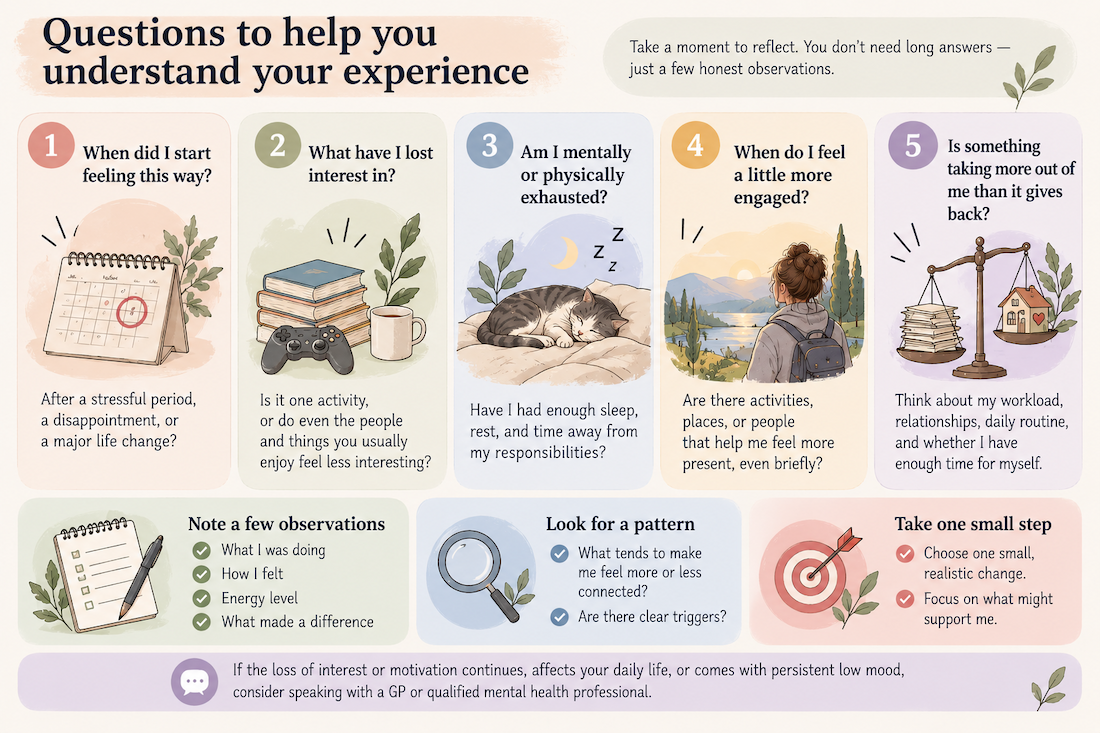
Here are a few questions that may help you understand your experience:
- When did I start feeling this way? Think back to when you first noticed the change. Was it after a stressful period, a disappointment, or a major life change?
- What have I lost interest in? Is it one particular activity, or do even the people and things you usually enjoy feel less interesting?
- Am I mentally or physically exhausted? Consider whether you’ve had enough sleep, time to rest, and space away from your responsibilities.
- When do I feel a little more engaged? Notice whether certain activities, places, or people make it easier to feel present, even briefly.
- Is something in my life taking more out of me than it gives back? Think about your workload, relationships, daily routine, and whether you have enough time for yourself.
You don’t need to write long answers. Try noting down a few observations over several days: what you were doing, how you felt, how much energy you had, and whether anything made a difference.
Over time, you may notice a pattern. Perhaps you feel more disconnected after a demanding day, or you find it easier to engage when you spend time outside or talk to someone you trust. These observations won’t necessarily explain everything, but they can help you recognise what supports you and what might need attention.
The aim isn’t to force yourself to find a reason or fix everything immediately. It’s to understand what has changed and identify one small, realistic step you can take next.
If the loss of interest or motivation continues, affects your daily life, or comes with persistent low mood, consider speaking with a qualified mental health professional.
How apathy can show up
Apathy can affect your thoughts, body, and behaviour. You may recognise some of these signs, but you don’t need to experience all of them to describe yourself as feeling apathetic.
In the Mind
Apathy may show up as:
- Finding it difficult to feel excited about things.
- Losing interest in hobbies or personal goals.
- Thinking, “What’s the point?”
- Struggling to make decisions because nothing feels particularly appealing.
- Feeling indifferent about outcomes you would usually care about.
- Finding it difficult to imagine something to look forward to.
- Feeling disconnected from your own goals or priorities.
- Knowing something matters but struggling to feel motivated to act.
You might not feel particularly sad or upset. Instead, your emotional response may feel muted, as though things simply don’t affect you as much as they used to.
In the Body
Apathy doesn’t have one specific physical sensation, but it may occur alongside:
- Feeling tired or low on energy.
- Finding it harder to get out of bed or start the day.
- Feeling physically sluggish.
- Wanting to sit or lie down for long periods.
- Experiencing changes in your sleep.
- Finding ordinary tasks more effortful than usual.
These physical experiences can have many causes. If they’re persistent or unusual for you, it’s worth considering your overall health rather than assuming they’re simply part of apathy.
In Behavior
You might notice yourself:
- Putting off tasks even when they seem manageable.
- Spending less time on hobbies you used to enjoy.
- Replying to messages less often.
- Avoiding plans because you don’t feel interested.
- Going through your routine without feeling involved.
- Letting personal projects drift.
- Struggling to take initiative.
- Waiting for motivation before doing anything.
Apathy isn’t always visible to other people. You may continue working, meeting deadlines, and appearing fine while privately feeling disconnected from what you’re doing.
Apathy or simply having an off day?
Everyone has periods when they feel unmotivated, bored, or tired. One quiet weekend or an unproductive afternoon doesn’t necessarily mean anything is wrong.
What matters more is the pattern. Is this a temporary dip, or has your usual interest in several areas of life noticeably changed? Are you enjoying your free time once you get started, or does even doing something familiar feel unrewarding?
There is no single answer that identifies apathy, and these signs aren’t a diagnostic checklist. Paying attention to how long these changes last and how they affect your everyday life can help you better understand what you’re experiencing.
How to work with apathy
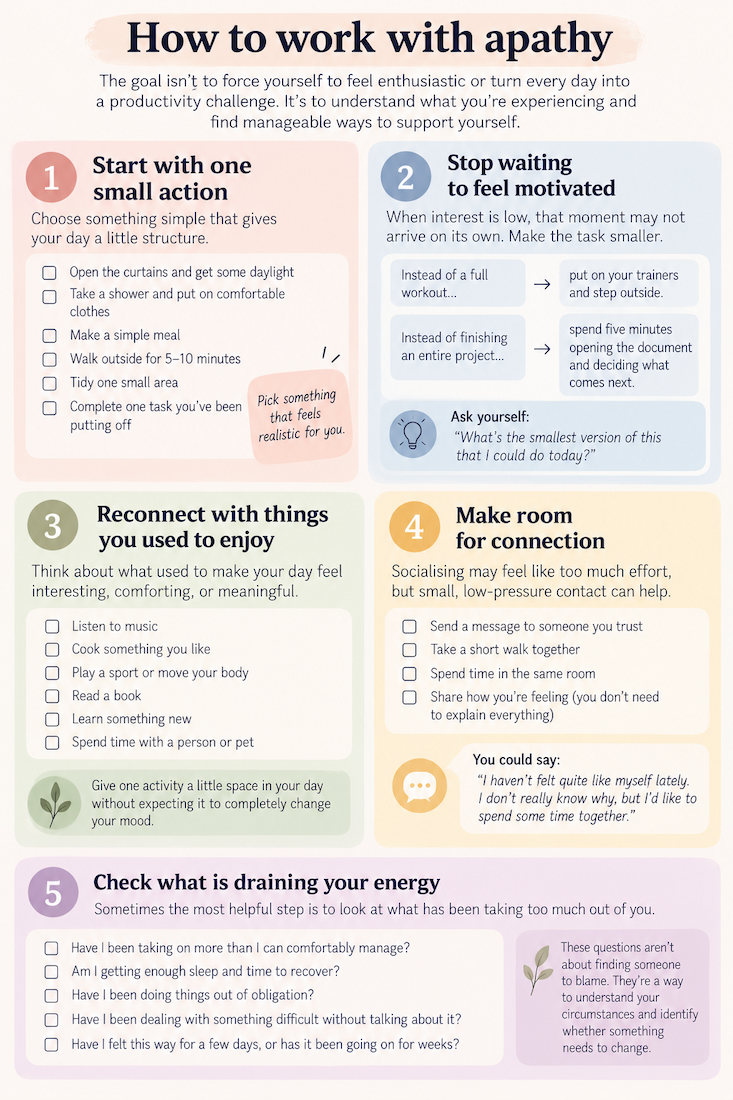
The goal isn’t to force yourself to feel enthusiastic or turn every day into a productivity challenge. It’s to understand what you’re experiencing and find manageable ways to support yourself.
When motivation is low, even a small action can feel like a lot. Try to make the next step easier rather than expecting yourself to suddenly feel different.
Start with one small action
When nothing feels particularly interesting, don’t put pressure on yourself to find a new passion or completely change your routine.
Choose something small that gives your day a little structure.
You could:
- Open the curtains and get some daylight.
- Take a shower and put on comfortable clothes.
- Make yourself a simple meal.
- Walk outside for five or ten minutes.
- Tidy one small area.
- Complete one task you’ve been putting off.
Pick something that feels realistic, not something that would impress someone else.
You may not immediately feel happier or more motivated afterwards. That’s okay. The point is to make it easier to participate in your day, one step at a time.
Stop waiting to feel motivated
When you feel apathetic, you might tell yourself, “I’ll do it when I feel like it.” But if interest and motivation are low, that moment may not arrive when you expect it to.
Instead, try making the task smaller.
Rather than committing to a full workout, put on your trainers and step outside. Rather than trying to finish an entire project, spend five minutes opening the document and deciding what comes next.
Ask yourself:
“What’s the smallest version of this that I could do today?”
You don’t have to finish everything you start. Sometimes getting going is enough.
Reconnect with things you used to enjoy
Think about what used to make your day feel interesting, comforting, or meaningful.
It could be listening to music, cooking, playing a sport, reading, learning something new, or spending time with a particular person.
Choose one activity and give it a little space in your day without expecting it to transform your mood.
If it feels enjoyable, notice that. If it feels ordinary, you haven’t failed. You may need more time, a different activity, or support with something else that’s affecting you.
The aim is to explore what feels right for you now, rather than forcing yourself to feel exactly as you did in the past.
Make room for connection
When you feel apathetic, socialising may seem like too much effort. You might cancel plans or stop reaching out, even when you miss feeling close to people.
Try starting with low-pressure contact. Send a message to someone you trust, take a short walk together, or spend time in the same room without needing to have a big conversation.
You could say:
“I haven’t felt quite like myself lately. I don’t really know why, but I’d like to spend some time together.”
You don’t need to explain your feelings perfectly to let someone support you.
Check what is draining your energy
Sometimes the most helpful step isn’t adding another activity to your day. It’s looking at what has been taking too much out of you.
Ask yourself:
- Have I been taking on more than I can comfortably manage?
- Am I getting enough sleep and time to recover?
- Have I been doing things out of obligation without making room for my own needs?
- Have I been dealing with something difficult without talking about it?
- Have I felt this way for a few days, or has it been going on for weeks?
These questions aren’t about finding someone to blame. They’re a way to understand your circumstances and identify whether something needs to change.
What can make apathy worse?
When you’re already feeling disconnected, certain patterns may make it harder to re-engage with everyday life.
These can include:
- Criticising yourself for not being motivated.
- Comparing yourself with how productive or enthusiastic you used to be.
- Expecting one activity to fix everything.
- Withdrawing from people for long periods.
- Taking on too many responsibilities at once.
- Ignoring ongoing stress or exhaustion.
- Waiting for a strong sense of purpose before taking any action.
Try not to turn self-care into another list of things you must do perfectly. Choose one or two manageable changes and see whether they help.
And remember: if your apathy is persistent, you don’t have to solve it through willpower alone.
How to work with apathy over time
If apathy keeps returning, it can help to notice when it appears and how it affects your everyday life.
You might keep a simple record of:
What happened → How I felt → What I needed → What I did
For example, you might notice that you feel particularly disconnected after a demanding week, when your sleep has been disrupted, or when you’ve had little time for activities that matter to you.
You could also note which activities feel manageable, when you feel more engaged, and whether anything seems to make the experience worse.
Over time, these observations may help you recognise patterns and make more informed decisions about your routine, responsibilities, and support needs.
Helpful habits may include:
- Keeping a reasonably consistent sleep routine.
- Eating regular meals.
- Including gentle movement in your day.
- Staying connected with people you trust.
- Breaking responsibilities into smaller steps.
- Making time for activities that reflect your interests and values.
- Allowing yourself to rest without treating it as a failure.
You don’t need to change everything at once. Small adjustments can help you understand what supports you, even if they don’t immediately change how you feel.
Final thought
When you feel apathetic, it can be hard to imagine feeling interested, inspired, or connected to life again. But the way you feel right now doesn’t have to define what comes next.
You don’t need to wait for motivation to return before you take a step forward. Start where you are, give yourself permission to move at your own pace, and stay open to the small things that bring a little meaning or connection back into your day.
You may not see a big change straight away, and that’s okay. Progress can begin quietly — with one small choice, one moment of curiosity, or one step towards something that matters to you.
You don’t have to find your spark all at once. Give yourself the time and space to rediscover it, one step at a time.